
Planning your strategy
Strategy is about achieving your objective by moving one step at a time.
Strategy is about position: being in the right place at the right time by understanding your current position, deciding the next best position to advance to, and planning the actions to do that. It applies to any goal you cannot reach in a single move, whether that is winning a complex sale, delivering a project, making a career change or leading an organisation through change.
A Complex Sale is one involving multiple decision-makers (Buyers) and strategy in that context is about discovering who the Buyers are, how they will decide, and how best to guide them to their best decision. The DECIDE Method enables Sellers to plan their strategy by objectively assessing their current position in relation to winning the sale and selecting the next best position to advance to.
Tactics is about moving into position, i.e., the actions necessary to do so.
In simple terms, strategy is about deciding which Buyers to interact with about what, and tactics is about how to have the conversations.
The DECIDE App uses this model for planning opportunity strategy, and PatrickAI covers the tactics.
Strategy and tactics
Both matter, and they are different things.
| What it is | A sporting comparison | |
|---|---|---|
| Strategy | Where you need to be, and what you need to know and do next to move forward. | Position play |
| Tactics | How you carry out each action, including how you have the conversations. | Ball skills |
You need both. Good tactics from the wrong position rarely win, and a good strategy is wasted without the skills to implement it.
The usual plan, and why it fails
Most traditional plans look like the top strip of the diagram below: a start point, a series of steps, and a goal at the end. In the case of the traditional sales model, it is represented as a sales cycle with steps such as needs discovery, a demonstration, a quotation and so on.
Real progress rarely follows that line as when a plan is executed the position you end up in is rarely the one you planned. As military planners say, 'the map is not the ground.'
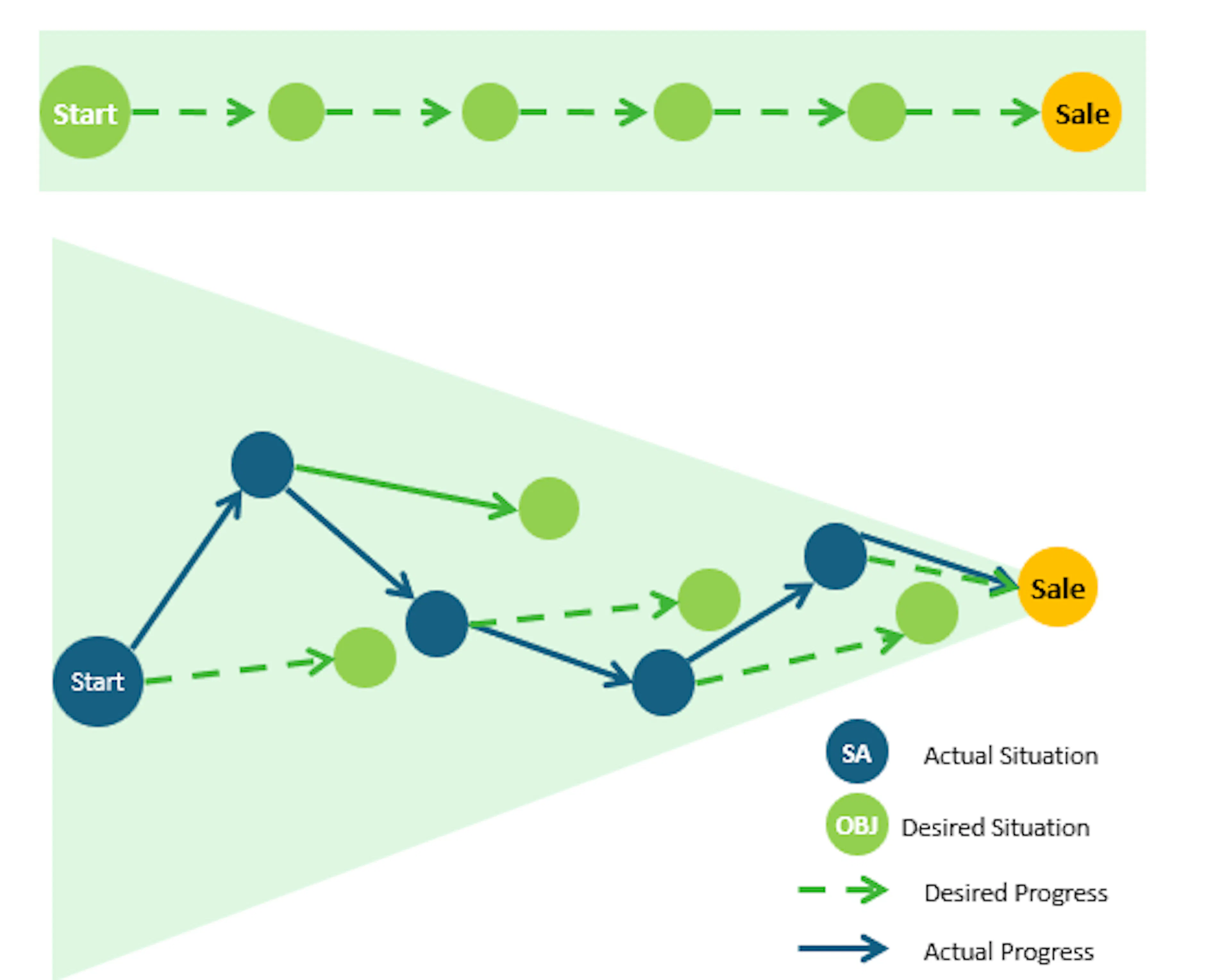
Top: the straight-line plan. Bottom: what really happens. Each appraisal (SA) shows where you actually are, and the next objective (OBJ) is set from there.
The strategy cycle
Instead of planning the whole journey, strategy works as a cycle that you repeat.
| Step | The question | What you do |
|---|---|---|
| 1. Appraise | Where am I now? | Take stock of your actual situation, including what you do not yet know. |
| 2. Decide | What is the best next position? | Choose the next best position to progress to, and plan the action to reach it. |
| 3. Act | How should I execute? | Carry out that one step. |
| 4. Arrive | Where did I actually end up? | Notice that you are somewhere slightly different from where you aimed. |
| 5. Appraise again | Where am I now? | Start the cycle again from your real position. |
You keep going round the cycle until you reach the goal. In a sale, that is the Sale.
Reading the diagram
The funnel in the diagram shows what happens in practice.
| Symbol | Meaning |
|---|---|
| SA (dark blue circle) | Actual Situation: where you really are, as shown by a Situation Appraisal |
| OBJ (green circle) | Desired Situation: the next position you decided to aim for |
| Dashed green arrow | Desired Progress: the move you planned |
| Solid blue arrow | Actual Progress: the move you actually made |
Each time, the dark blue circle lands a little away from the green one. That gap is to be expected, and it is the reason you appraise again to confirm where you are before choosing the next position.
The funnel narrows towards the Sale because each cycle removes uncertainty. Early on there are many possible directions. With every appraisal, you understand more about where the goal really is, and the range of sensible moves gets smaller.
Why plan only the next step
Your start point is often not what you think it is. Through history, strategies have failed not so much because of how they were implemented, but because their starting position was misread. If you're not where you think you are, then every step you take from there is built on a false premise and your strategy is doomed to fail.
By moving in small steps, you never go so far you're unable to correct course.
You cannot act on the future. The only place you can take action is the present. Planning many steps ahead pulls attention away from the step in front of you, which is the one that matters and that you have the most control over.
As the Japanese saying goes: "If you talk about tomorrow, the demons will laugh."
The first step is the one you can plan properly. You know most about it, and you can prepare for it in detail. Steps further out depend on where you actually land, so they are best kept loose.
Plans meet reality. After each step you will find you are not exactly where you expected. A short, honest appraisal costs very little, and it prevents you from carrying on down a path that no longer leads where you want to go.
Strategy beyond sales
The same cycle works for any goal with more than one move.
- A project: appraise the current state of the work and the team, choose the next milestone, deliver it, then reassess before committing to the one after.
- A career change: take stock of your skills, contacts and constraints, choose the next position (a conversation, a course, a role), take it, and see what it opens up.
- A negotiation: appraise each party's position and interests, choose what to explore or propose next, then reassess when you see how the other side responds.
- Leading change: appraise how people are feeling and what is blocking progress, choose one thing to shift, act, and see what has moved.
In each case the habit is the same: know your real position, move to a stronger one, and look again.
In the DECIDE App
The App follows this cycle for each opportunity.
- You complete a Situation Appraisal: what you know, and do not yet know, about the opportunity and the Buyers.
- The App helps you decide the next best step e.g., which Buyer(s) to interact with, about what (see The DECIDE steps).
- You take that step, then update your appraisal with what actually happened.
- You repeat; 'look up' to determine the best path to the objective (the sale) and then 'look down' to focus on the immediate next position. This bears repeating. Your objective at this point is advancing to your next position, not the sale.
To judge where each Buyer stands, see Buyer Types and Motivation and Support.
Common traps
- Planning the whole journey up front. It feels thorough, but it commits you to a path before you know where you will actually be.
- Skipping the appraisal. Acting on the position you expected rather than the one you are in.
- Treating the gap as failure. Landing off target is normal. The skill is in noticing it and responding.
- Confusing activity with progress. A step only counts if it moves you to a stronger position.